



Forex Broker Swap-Free Account Conditions Explained
By Joanne Cassar / 16. Oct 2026
read more
By Joanne Cassar / 16. Oct 2026

IC Markets - Regulated By FSA
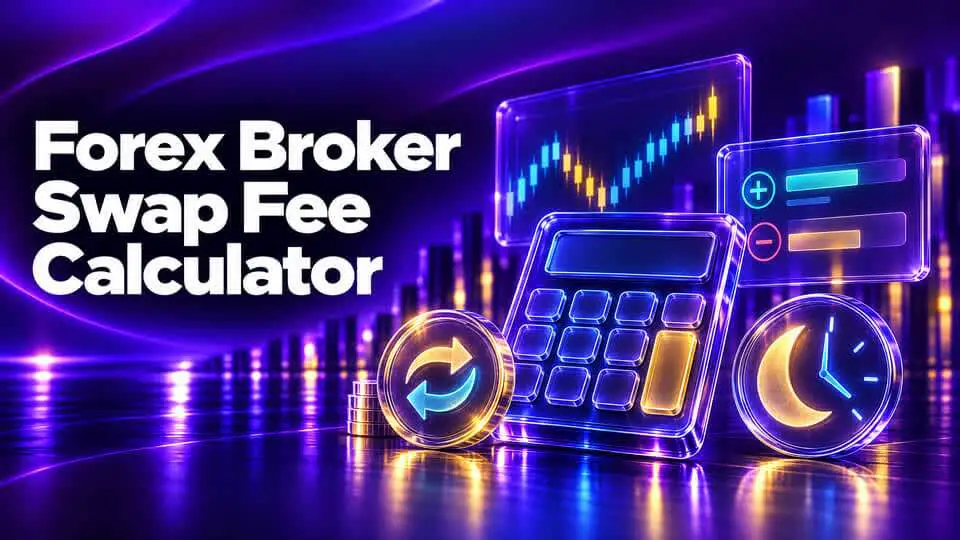
A forex broker swap fee calculator helps traders estimate the financing charge or credit associated with holding a position overnight. The amount may depend on the instrument, trade direction, position size, broker’s swap rate, and number of rollover events.
The calculator above provides a simplified estimate when you know the swap rate per lot per night. It allows you to enter the position size, normal swap nights, and triple-swap events. Since brokers can use different calculation methods, the result should be treated as an estimate rather than a guaranteed account charge.
To calculate the amount more accurately, find the current swap rate and instrument specifications in your broker’s trading platform or official fee schedule.
A forex swap, also called an overnight financing adjustment or rollover charge, is an amount applied to a position that remains open across the broker’s designated rollover time. Depending on the instrument, direction, and broker’s methodology, the adjustment can be negative or positive.
A negative swap typically represents a charge deducted from the account. A positive swap may represent a credit added to the account. Whether a position receives a credit is not guaranteed, and swap rates can change.
Swap is separate from the bid–ask spread and any commission charged when opening or closing a trade.
For an explanation of how swap works and how rates are displayed in trading platforms, see Exness’s swap guidance and Ultima Markets’ overnight fee guide. <Cite refs={["turn477458search2","turn477458search1"]}/>
Check the long and short swap rates for the instrument you intend to trade. A buy position and a sell position may have different rates.
Use the lot size that matches your trade. If the swap rate is quoted per lot, the position size is needed to scale the estimate.
Estimate the number of rollover events that will occur while your position is open. A position held for two calendar days does not necessarily incur exactly two standard swap charges because the broker’s rollover schedule and settlement calendar matter.
Some instruments have a designated rollover event where a charge or credit equivalent to three standard days is applied. The day varies by instrument and broker. Enter a triple-swap event only if it applies to the instrument and period you are calculating.
Use the result for planning, then confirm the actual amount through the broker’s current specification and account records.
For a broker that publishes a fixed swap amount per lot per night, a simplified formula is:
Estimated swap = swap rate per lot × lot size × applicable swap-day multiplier
For example, suppose the published rate is −$5 per lot per standard night, the position size is 1 lot, and the position incurs two normal swap nights plus one triple-swap event.
Estimated swap = −$5 × 1 × (2 + 3) = −$25.
Under these assumptions, the estimated financing charge is $25. The example is hypothetical; it does not represent a current quote from a specific broker.
If the broker quotes swap in points, pips, or as a percentage of contract value, this simplified dollar formula may not be suitable without converting the published rate correctly.
Swap rates can vary because providers use different pricing arrangements, financing inputs, markups, and calculation methods. Rates may also differ between instruments and between long and short positions.
When comparing brokers, check:
Do not assume the same currency pair will have identical swap costs across providers.
The exact interface depends on the platform and broker. On MetaTrader 4 or MetaTrader 5, swap information is commonly available in the instrument’s specification or properties window.
A general process is:
If the platform displays swap in points, do not automatically treat the number as a dollar amount. You may need the contract size, point value, and instrument specifications to calculate the cash impact.
Swap generally relates to positions held across the broker’s rollover time. A position opened and closed before that time may avoid an overnight adjustment, but the applicable rollover cutoff is determined by the broker and product.
Some products have different trading hours and settlement conventions. A holiday or market-specific schedule can also change when the financing adjustment occurs.
Therefore, use the broker’s published rollover time rather than assuming it matches midnight in your local time zone.
Triple swap is a multiple-day financing adjustment applied at a designated rollover to account for settlement conventions and days when markets are closed. The relevant day varies across products and providers.
For example, one broker may apply a three-day swap to certain forex instruments on Wednesday, while another instrument may have a different schedule. Always check the current product specification rather than assuming Wednesday is universal.
Triple swap does not necessarily mean that the broker has introduced a new fee. It may represent financing for several calendar days being applied at one rollover event. <Cite refs={["turn477458search2","turn477458search9"]}/>
|
Cost |
Meaning |
|
Swap or overnight financing |
Adjustment for holding an eligible position across rollover |
|
Spread |
Difference between bid and ask prices |
|
Commission |
Separate fee charged under the account’s pricing model |
|
Slippage |
Difference between requested and executed price |
|
Currency conversion |
Cost associated with converting amounts into the account currency |
A trader who closes all positions intraday may be less exposed to overnight financing than a trader who routinely holds positions for several days. However, spread, commission, and execution costs can still matter substantially.
Using the wrong direction. Long and short positions can have different swap rates.
Confusing points with money. A rate in points cannot always be entered directly as a cash amount.
Ignoring triple-swap events. The applicable schedule may add several days’ financing at once.
Using a stale rate. Swap rates can change, so check current information.
Forgetting position size. A rate per lot must be adjusted for the actual trade size.
Assuming every broker uses the same formula. The calculation method depends on the instrument and account terms.
No. Depending on the published rate and position direction, a swap can be negative or positive. A negative amount is generally a charge; a positive amount may be credited to the account.
The result can be accurate for the formula and inputs provided, but it depends on the broker’s current rate and calculation method. A simplified calculator may not capture percentage-based calculations, holidays, or other account-specific adjustments.
If the broker’s rate is a fixed amount per lot per night and scales proportionally, multiply the rate by 0.10 and the applicable number of swap days. Check for minimum fees or other conditions.
The instrument may have reached the broker’s designated multi-day rollover. Check the current swap schedule and the position’s timing to understand the adjustment.
Not necessarily. Some providers replace standard swaps with administrative or holding fees, while others impose product restrictions or time limits. Read the swap-free terms carefully.
Use the instrument specification in your trading platform and cross-check it against the broker’s official documentation. Make sure the rate’s unit and direction match your position.
A forex broker swap fee calculator can help estimate the cost or credit of holding a position overnight. For a useful estimate, enter the correct instrument rate, trade direction, lot size, and rollover schedule.
Because swap methods vary, confirm the calculation with the broker’s current terms. Include overnight financing in your planning alongside spread, commission, and the other risks and costs of leveraged trading.
Risk Notice: Forex and CFD trading involve substantial risk. Overnight financing can affect trading results, and leverage can magnify losses. This article and calculator are for educational purposes and are not financial advice.




By Joanne Cassar / 15. Oct 2026
read more