


How Forex Broker Entity Affects Negative Balance Protection
By Joanne Cassar / 14. Oct 2026
read more
By Joanne Cassar / 08. Oct 2026

IC Markets - Regulated By FSA
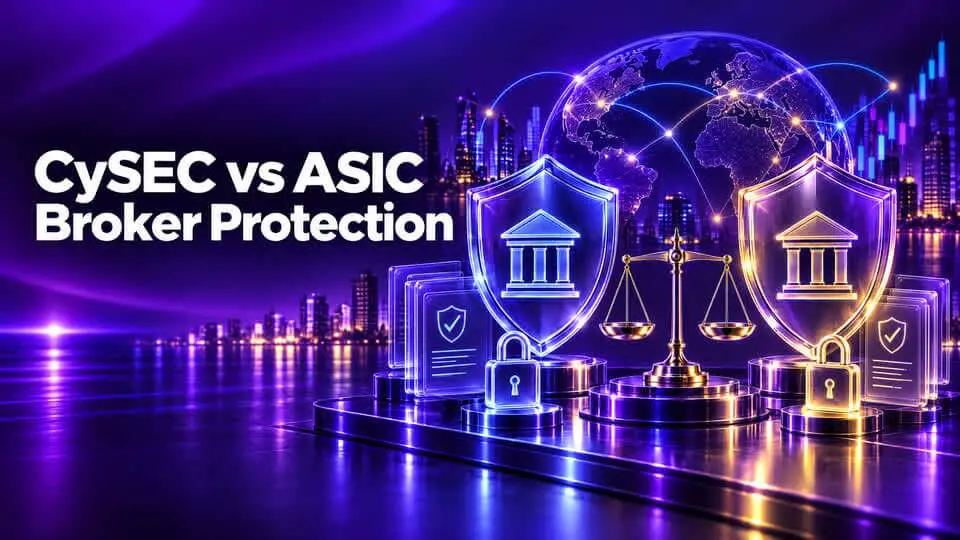
When comparing CySEC vs ASIC broker protection, the most important factors are the legal entity holding your account, the regulatory rules that apply to your product, and the remedies available if something goes wrong. Both the Cyprus Securities and Exchange Commission (CySEC) and the Australian Securities and Investments Commission (ASIC) supervise financial services firms, but they operate under different legal frameworks.
For forex traders, the regulator's name is only the starting point. A broker group may operate several companies in different countries, and international clients may be directed to an entity other than the one prominently advertised on the website. The protections attached to one company do not automatically extend to every affiliate.
This guide compares key protection categories, explains what compensation and negative balance protection mean, and provides a practical checklist for checking a broker before depositing money.
CySEC is the financial regulator of Cyprus. It supervises investment firms authorised in Cyprus and monitors compliance with the rules that apply to their regulated activities.
A CySEC-regulated investment firm may provide certain investment services, subject to its authorisation and applicable rules. The scope of permission matters: a firm's licence should be checked for the relevant activities rather than treated as general approval for every financial product.
CySEC also administers an Investor Compensation Fund (ICF) for eligible clients of participating investment firms. The ICF has specific eligibility conditions and is not insurance against ordinary trading losses.
ASIC is Australia's corporate, markets, and financial services regulator. It maintains registers of financial services licensees and other regulated professionals and organisations.
ASIC's regulatory framework includes product-intervention measures for retail contracts for difference (CFDs). Those measures include leverage restrictions, margin close-out arrangements, negative balance protection, and restrictions on certain inducements. These rules are intended to address risks associated with leveraged CFD products.
As with CySEC, an ASIC licence must be checked against the specific firm and activity. A brand's Australian licence does not prove that an overseas client has opened an account with the Australian entity.
|
Protection area |
CySEC framework |
ASIC framework |
|
Regulated entities |
Authorised investment firms in Cyprus |
Relevant Australian financial services licensees |
|
Retail CFD leverage |
Restrictions under the applicable EU/CySEC framework |
Restrictions under the Australian retail CFD framework |
|
Negative balance protection |
Relevant retail CFD protections apply under the applicable framework |
Included in the relevant retail CFD protections |
|
Margin close-out |
Applicable retail CFD rules govern requirements |
Standardised arrangements apply under ASIC's CFD measures |
|
Compensation |
ICF may cover eligible claims involving participating firms, subject to conditions |
Do not assume an ASIC licence creates a universal compensation guarantee |
|
Complaints |
Firm complaint process and applicable Cyprus/EU routes |
Firm complaint process and applicable Australian routes |
|
Cross-border access |
Depends on the firm's permissions and client location |
Depends on the firm's permissions and client location |
This table summarises broad regulatory approaches. It is not a guarantee that every account receives every protection. Product type, client classification, legal entity, and current rules all matter.
Negative balance protection is intended to limit an eligible retail CFD client's liability for covered CFD trading losses to the funds in the relevant CFD trading account.
This protection matters because leverage can cause losses to accumulate quickly when prices move sharply. A trader may hold a position much larger than the cash deposited as margin, so a rapid adverse move can create a loss that exceeds the available balance without appropriate protection.
The relevant CySEC/EU retail CFD framework and ASIC's retail CFD measures include negative balance protection for covered retail clients. However, you should not assume that the protection applies identically to all products or client classifications.
Before opening an account, check:
Negative balance protection does not prevent you from losing your entire account balance. It also does not make leveraged trading low-risk.
Leverage allows a trader to control a larger position with a smaller initial margin. It can amplify both profits and losses.
Both regulatory frameworks impose restrictions on leverage for relevant retail CFD products, but the exact application depends on the instrument and applicable rules. A broker may also set stricter limits than the legal maximum.
Margin close-out rules are designed to require positions to be closed when the account's margin falls to a specified level. They do not guarantee that a position will close at a particular price, especially during a gap or fast market.
When comparing brokers, review the margin policy and ask:
A broker offering the highest leverage is not necessarily offering the best protection. Lower leverage may help limit exposure, but traders must still manage position size and losses.
Compensation schemes are often misunderstood in forex marketing.
CySEC administers an Investor Compensation Fund for eligible clients of participating investment firms. Whether a client can claim depends on the fund's rules, the firm's participation and status, the type of claim, and other eligibility conditions.
The ICF should not be treated as a guarantee that a trader will recover losses from a bad trade, an unsuccessful strategy, or normal market volatility.
Before relying on it, identify the account entity and review official information about the fund and eligibility.
An ASIC licence alone should not be interpreted as a universal promise that a client will be reimbursed if a broker fails or a dispute arises. The applicable Australian legal arrangements and the specific circumstances of a claim matter.
Read the broker's disclosures carefully. If compensation is a major concern, seek qualified advice about the legal entity and the remedies available in your circumstances.
Never accept a broker's general statement that “client funds are protected” without understanding what the statement means.
Client-money rules and the handling of funds are important because the broker may hold money intended for margin or trading.
Where applicable rules require segregation, eligible client money is intended to be separated from the firm's own operating funds. But segregation is not the same as a guaranteed full refund in every insolvency scenario.
When evaluating a broker, read its client-money policy and check how deposits are held, whether third parties are involved, and what the firm says about handling a shortfall or insolvency.
Do not assume that the words “segregated funds” mean the account is risk-free. The legal entity, banking arrangements, applicable law, and circumstances of a firm's failure can affect recovery.
A regulated broker should explain how clients can submit complaints. However, the available external complaint route may differ depending on the jurisdiction and account entity.
Before depositing, find out:
Save order confirmations, statements, account terms, emails, and relevant screenshots. Clear records can help you explain a dispute, although they do not guarantee a particular outcome.
A broker brand may have one company regulated in Cyprus, another in Australia, and a separate entity serving international clients.
This structure means that a website's statement that the group is “regulated by ASIC and CySEC” is not enough. You must identify which company will actually provide your account.
Follow this process:
If a broker will not clearly identify the entity, do not rely on its brand-level regulatory claims.
There is no universal answer for every international client. A trader's country of residence may determine which entity is available, which legal rules apply, and which complaints or compensation routes can be used.
For traders in Bangladesh or another country outside Cyprus and Australia, check the broker's country-specific onboarding process. If the account is opened under a third-country affiliate, do not assume that CySEC or ASIC protections automatically apply.
Compare the exact account you can legally open, not an entity that is unavailable to you.
Be cautious if a broker:
A regulatory logo is not proof of authorisation. Verify the company independently.
Neither is universally better for every client. Compare the protections applicable to the specific account, including leverage restrictions, negative balance protection, client-money arrangements, complaints, and compensation eligibility.
The applicable retail CFD framework includes negative balance protection for covered retail clients. Check the current rules and the terms of the account entity you intend to use.
No. An ASIC licence does not mean every deposit or trading loss is guaranteed to be reimbursed. Understand the applicable legal arrangements and the firm's client-money disclosures.
It is not intended to reimburse ordinary market losses. The fund may cover eligible claims involving participating investment firms subject to its conditions.
A group may operate separate entities authorised by both regulators. Verify which company will open your account and which entity's protections apply to you.
The regulator supervising the company that actually provides your account is a key starting point. Also check local requirements, the account agreement, and the complaint routes available to you.
The CySEC vs ASIC broker protection comparison should focus on the actual protections attached to your account rather than a broad claim that one regulator is always safer.
Both frameworks include important rules for relevant retail CFD trading, but compensation, client-money arrangements, and cross-border access require careful checking. Verify the legal entity, read the account terms, and confirm each protection through official sources before depositing money.
Risk notice: Forex and CFDs are leveraged products and can cause substantial losses. Regulatory oversight does not eliminate trading risk.