



Forex Broker Hidden Fees: 12 Costs to Check in 2026
By Joanne Cassar / 18. Oct 2026
read more
By Joanne Cassar / 17. Oct 2026

IC Markets - Regulated By FSA
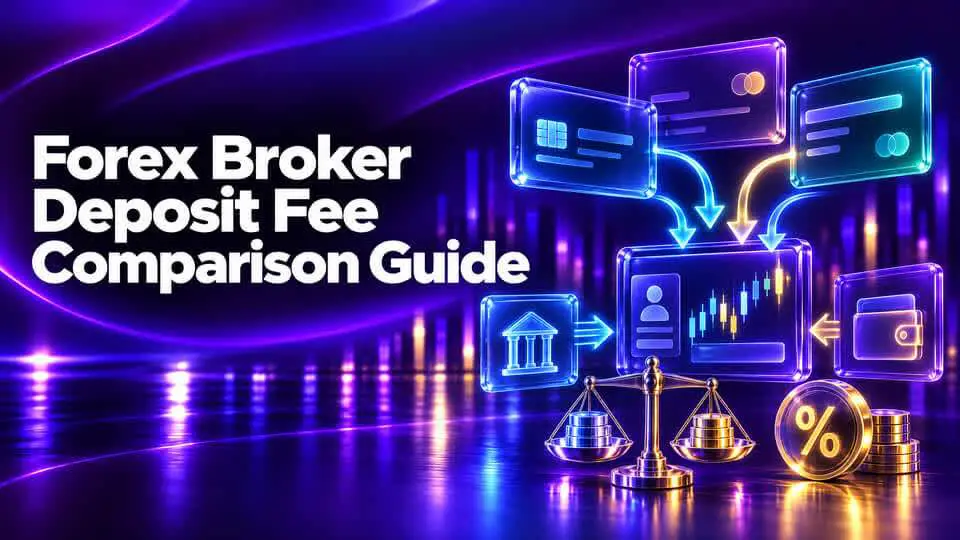
Before opening a trading position, you need to fund your account. Although many forex brokers advertise free deposits, the amount you pay to move money into a trading account can depend on your payment method, currency, country, and account entity.
A proper forex broker deposit fee comparison looks beyond the broker's advertised charge. It considers card fees, bank transfer costs, e-wallet charges, currency conversion, and any minimum deposit requirements that may influence the total cost.
For example, FxPro and XM publish policies stating that they do not charge deposit fees under their stated terms, but third-party payment charges and method-specific conditions can still matter.
This guide explains how to compare deposit costs accurately, identify hidden charges, and choose a funding route that suits your circumstances.
A deposit fee is a charge associated with transferring money from your bank account, card, e-wallet, or another supported payment method into a trading account.
The cost may come from the broker or from another provider involved in the transaction.
Common charges include:
A broker's zero-fee policy normally describes the fees charged by the broker itself. It should not automatically be interpreted as a guarantee that every third party will process the transaction for free.
|
Payment method |
Potential costs |
Key checks |
|
Bank transfer |
Sending, receiving, and intermediary-bank charges |
Total transfer cost and settlement currency |
|
Debit or credit card |
Issuer or transaction fees; possible currency conversion |
Whether the issuer treats the payment as a cash advance or another transaction category |
|
E-wallet |
Funding, transfer, and currency-exchange fees |
Costs to fund and later withdraw from the wallet |
|
Cryptocurrency |
Network fees and exchange/conversion costs |
Correct blockchain network, supported assets, and destination details |
|
Local payment method |
Provider-specific transaction or conversion fees |
Availability, limits, and eligibility in your country |
Actual costs vary. Review both the broker's current funding page and the payment provider's own fee schedule.
The first step is to identify who charges each fee.
This is a charge imposed by the broker for receiving funds. Some brokers state that they do not impose such charges for supported methods.
Your bank or card issuer may apply a transaction fee or a foreign-currency conversion rate. The precise treatment depends on the provider and the transaction.
International bank transfers may pass through one or more intermediary banks. Those institutions may deduct charges before the money reaches the broker.
If your payment currency differs from your account currency, a provider may convert the funds at its applicable exchange rate. The cost may appear as a separate fee or as a difference between the exchange rate offered and a reference rate.
Cryptocurrency transactions may require a blockchain network fee. That fee is separate from any amount charged by the broker or crypto service.
Use this formula:
Total deposit cost = broker fee + bank/payment-provider fees + intermediary charges + currency-conversion cost + network fees
Consider a hypothetical deposit of $500 with these costs:
Total deposit cost = $4 + $3 = $7.
If the trader spends $507 to get $500 credited to the trading account, the effective deposit cost relative to the credited amount is:
[
\frac{7}{500}\times100=1.4%
]
These are illustrative figures, not actual fees from a specific broker.
Official broker pages are the best place to begin, but their terms must be checked against your own account and country.
These examples demonstrate why traders should read the details rather than assume that every customer, method, and currency has identical terms.
The most suitable method depends on the size of your deposit, the currencies involved, settlement speed, and the fees charged by the broker and payment provider.
Bank transfers may be suitable for larger deposits, but international transfers can involve sending-bank and intermediary-bank costs. Ask your bank for an estimate before making a transfer.
Card deposits can be convenient, but check the issuer's transaction rules and any currency-conversion charges. Confirm that the card is accepted by the broker and belongs to the account holder.
E-wallets can provide a convenient way to transfer funds, but funding the wallet and later withdrawing money may incur separate costs. Compare the complete round trip if you expect to withdraw regularly.
Crypto deposits may involve network fees and exchange costs. Ensure that the broker supports the exact asset and network you intend to use. Sending funds through an unsupported network can cause delays or permanent loss.
Some brokers provide country-specific funding options. Availability and limits depend on the broker's legal entity and the customer's location. Confirm the method through the secure client portal rather than relying on an old promotional page.
Traders in Bangladesh should confirm payment availability and local requirements before choosing an international forex broker.
Check the following before sending funds:
Do not assume that a payment method advertised for another country will be available to you. Nor should you assume that a broker's overseas regulation automatically authorizes every kind of cross-border transaction for a Bangladeshi resident.
These are different concepts.
The minimum deposit is the smallest amount a broker or payment method permits you to fund. A deposit fee is a charge for processing the transaction.
A broker might offer zero deposit fees but require a relatively high minimum amount for a particular account or payment method. Another might permit a smaller deposit but involve third-party fees.
Compare both factors alongside the account's minimum trade size, spreads, commissions, and margin requirements. A low minimum deposit does not necessarily mean that the trading account is economical or appropriate for a beginner.
Use the same deposit amount and currency for each provider.
|
Comparison field |
Broker A |
Broker B |
Broker C |
|
Legal entity |
Verify |
Verify |
Verify |
|
Available method |
Confirm |
Confirm |
Confirm |
|
Broker deposit fee |
Enter fee |
Enter fee |
Enter fee |
|
Bank/provider fee |
Enter fee |
Enter fee |
Enter fee |
|
Currency-conversion cost |
Enter cost |
Enter cost |
Enter cost |
|
Minimum deposit |
Enter limit |
Enter limit |
Enter limit |
|
Processing time |
Confirm |
Confirm |
Confirm |
|
Net amount credited |
Calculate |
Calculate |
Calculate |
Calculate the amount credited:
Net amount credited = amount sent − all applicable fees and deductions
If conversion is involved, calculate the result using the actual rate applied by the provider. A comparison that ignores exchange-rate differences can incorrectly label one method as cheaper.
Assuming zero broker fees means zero total costs. Other providers may charge independently.
Ignoring the exchange rate. Currency conversion can create a cost even when no separate fee appears.
Comparing different currencies. Compare the same amount and settlement currency wherever possible.
Overlooking bank intermediaries. International transfers can involve deductions outside the broker's control.
Using an unsupported payment route. Verify availability in the client portal before sending funds.
Depositing before verifying the account. Incomplete verification may delay transactions or require additional checks.
Sending funds from someone else's account. Brokers may reject third-party deposits under their payment and compliance policies.
There is no universal answer. Compare the current broker fee, third-party charges, currency-conversion cost, and payment methods available for your country and account entity.
Some brokers do not charge their own deposit fees, but banks, card issuers, e-wallets, and other payment providers may still impose charges.
It depends on the transaction amount, bank fees, card issuer rules, and currency conversion. Compare the total cost rather than the payment method alone.
That depends on the broker's supported currencies and payment methods. Conversion may apply, so check the exchange rate and any associated charges.
No. Deposit requirements are separate from spreads, commissions, overnight financing, slippage, and the risks of leveraged trading.
Review the broker's official funding terms, ask your payment provider about its charges, check the conversion rate, and verify the available method before sending money.
A useful forex broker deposit fee comparison measures the full cost of getting money into a trading account. A broker that charges no deposit fee may still involve bank charges, currency-conversion costs, or other third-party expenses.
Before funding your account, verify the legal entity, available payment methods, minimum deposit, total charges, settlement currency, and applicable local requirements. Keep a record of the terms and transaction confirmation for future reference.
Risk notice: Forex and CFD trading is risky and leverage can magnify losses. Deposit costs are only one part of trading expenses and do not indicate whether a broker is safe or suitable. This article is for educational purposes and is not financial or legal advice.