OctaFX Demo vs Real: Mobile-First Transition And The APAC Behavioural Gap
By Joanne Cassar / 12. Oct 2026
read more
By Joanne Cassar / 01. Oct 2026

IC Markets - Regulated By FSA
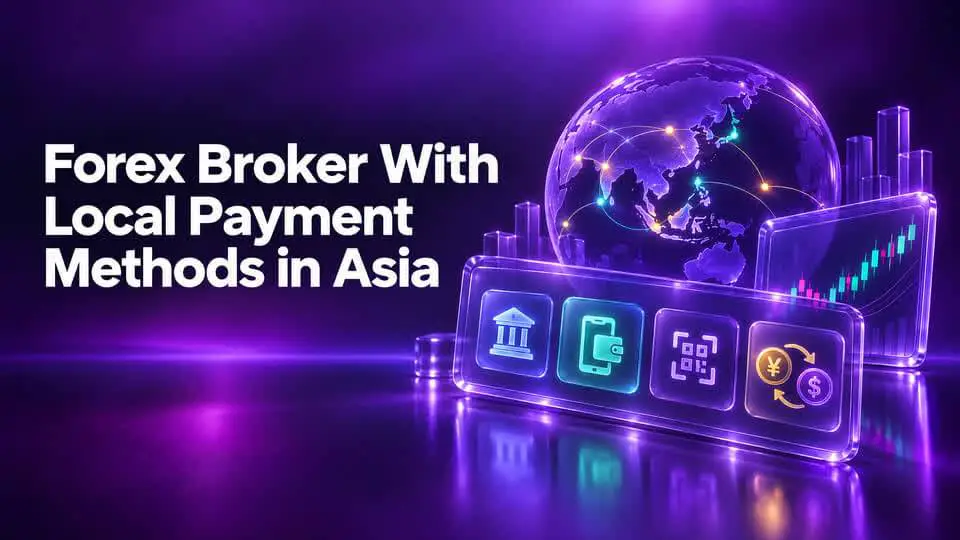
Payment convenience is one of the most underrated factors in broker selection for Asian traders, because a broker with excellent trading conditions is not very useful if you cannot fund or withdraw from your account reliably in your own country.
FBS is relevant to this search because FBS currently states it supports over 200 deposit and withdrawal methods, a figure that suggests broad regional payment coverage, though the exact methods available to you will still depend on your specific country and the entity that serves it. This guide explains the categories of local payment methods available across Asia, what to check before relying on any of them, and how to verify that a specific method is both convenient and safe for your situation.
Traders often spend hours comparing spreads and leverage, then give almost no thought to how they will actually move money in and out of an account. This is a mistake for several reasons:
Available almost everywhere, this sends funds directly from your bank account to the broker's named corporate bank account abroad. It typically offers the clearest paper trail but can involve intermediary bank fees, processing delays of several days, and exchange-rate markups.
Some brokers, including FBS in various regions, integrate with local payment processors that allow you to pay through your domestic bank's online transfer system, which the processor then routes internationally. This can be faster than a traditional wire but adds a processor fee layer.
Widely supported, though subject to your card issuer's own foreign-transaction policies, and in some countries subject to central bank restrictions on foreign currency card use for this specific purpose.
This is where Asia's payment landscape becomes genuinely diverse:
|
Country |
Common Local E-Wallet or Mobile Payment Options |
|
Indonesia |
GoPay, OVO, local bank transfer |
|
Philippines |
GCash, local bank transfer |
|
Bangladesh |
bKash, Nagad (subject to significant legal caveats, see below) |
|
Pakistan |
JazzCash, EasyPaisa (subject to significant legal caveats, see below) |
|
Malaysia |
Local online banking (FPX-style transfers), select e-wallets |
|
Vietnam |
Local bank transfer, select e-wallets |
|
India |
UPI and local bank transfer, subject to significant legal caveats for forex specifically |
Availability of any specific method depends entirely on the individual broker and the legal entity serving your country, and changes over time as processors add or drop support for specific regions.
Increasingly offered as a funding option across the region, cryptocurrency transfers can bypass some local banking friction but introduce their own risks: price volatility between sending and crediting, irreversible transfers if an address is entered incorrectly, and, in several Asian jurisdictions, an unclear or restrictive legal position on using crypto for this specific purpose.
Before choosing any payment method, understand that its legality for funding an offshore forex broker differs meaningfully across Asia:
This article is not a substitute for checking your own country's specific rules. If you are in Bangladesh, Pakistan, India, Malaysia, Indonesia, the Philippines, Nigeria, or the UAE, refer to the country-specific guide for your market and take qualified local legal advice before choosing a funding method.
FBS currently advertises support for over 200 deposit and withdrawal methods globally, spanning bank transfers, cards, e-wallets, and cryptocurrency, and states that specific options are tailored by region. This kind of broad stated coverage is a useful signal that a broker has invested in regional payment infrastructure, but it should not be taken as confirmation that every method is available, cost-free, or currently legal for your specific country. Confirm the exact methods shown to you during your own account registration, since marketing pages describing aggregate global coverage do not always reflect what is actually offered in your region.
Whatever method you use, the account or merchant name receiving your payment should match the legal entity disclosed in the broker's client agreement, not an unnamed individual or unrelated third party.
Add together the processor's fee, any card foreign-transaction fee, and the exchange-rate markup, since these frequently exceed the broker's own advertised deposit fee.
Most regulated brokers return withdrawals to the original deposit method up to the deposited amount, as a standard anti-money-laundering practice. Confirm this before assuming you can freely choose a different withdrawal method later.
Before committing significant capital, send a small deposit and attempt a small withdrawal to confirm the full round trip works as expected, including timing and actual fees charged.
Save confirmation screenshots, transaction references, and correspondence with support for every deposit and withdrawal, both for dispute resolution and for any future tax reporting.
Paying an unnamed individual who promises to credit your trading account, common in several Asian markets, removes any legal protection and is a frequent feature of scams. Avoid this regardless of how convenient it seems.
|
Method |
Typical Speed |
Typical Fees |
Legal Considerations in Your Country |
Notes |
|
Bank wire |
1–5 business days |
Bank + intermediary fees |
Check your country's forex funding rules |
Clearest paper trail |
|
Card |
Minutes to hours |
Card foreign-transaction fee |
Check issuer and local restrictions |
Refund-to-card policies on withdrawal |
|
E-wallet/local processor |
Minutes to 1 day |
Processor fee, conversion spread |
Varies significantly by country |
Convenient but check provider terms |
|
Cryptocurrency |
Minutes to hours |
Network + exchange fees |
Often legally unclear; verify locally |
Irreversible if address is wrong |
Fill in your own research for the specific broker and country you are considering, rather than relying on general figures.
Almost every forex broker account is denominated in USD, EUR, or occasionally GBP, while most Asian traders think and budget in their home currency. This creates a conversion step at both deposit and withdrawal, and the cost of that conversion is frequently larger than any fee the broker itself charges.
Consider a worked example. You deposit the local-currency equivalent of $300 through an e-wallet that applies a 2% exchange-rate markup, plus a fixed $2 processor fee. You then trade and grow the account by 10%, to $330. On withdrawal, the same e-wallet applies another 2% markup plus a $2 fee. The total conversion and fee drag across both legs is roughly $14 to $16, or about 4 to 5% of your original deposit, before you even account for any spread or commission paid while trading. Always calculate this round-trip cost before assuming a "no deposit fee" broker is actually cheap to use from your country.
Rather than trusting a broker's marketing claims about "instant" or "fee-free" payments, build a simple test over your first few weeks:
A broker that performs well on this simple test is telling you more about its real-world reliability than any star rating or affiliate review ever could.
Whichever payment method you choose, a properly regulated broker will require identity verification (KYC) before releasing withdrawals, in line with global anti-money-laundering standards. This typically includes:
Complete this verification as early as possible, ideally right after opening your account, rather than waiting until you attempt your first withdrawal. A broker that allows large deposits without ever requesting this documentation should be treated as a warning sign rather than a convenience, since it suggests weak compliance controls that could equally affect your ability to withdraw later.
There is no single definitive answer, since exact availability depends on your country and the specific legal entity serving you. FBS is a relevant example to research because it states it supports over 200 global deposit and withdrawal methods, but always confirm what is actually offered during your own registration process.
Safety depends on whether the payee is the broker's verified legal entity and whether using that method for this purpose is consistent with your country's rules. Bangladesh and Pakistan in particular have specific legal restrictions on sending money abroad for speculative trading that traders should understand before using any local mobile payment method for this purpose.
Regulated brokers commonly require withdrawals to return to the original deposit method up to the deposited amount, as standard anti-money-laundering practice. Confirm this with your specific broker before assuming flexibility.
It can bypass some local banking friction, but it carries price volatility risk, irreversible-transfer risk, and an unclear legal position in several Asian countries. Verify the legal status in your specific country before relying on it.
Refer to your country's central bank and securities regulator directly, and consult a qualified local lawyer or financial adviser, since rules differ significantly even between neighbouring Asian countries.
Payment method selection deserves the same scrutiny as spread and leverage comparison, because funding friction, legal risk, and withdrawal reliability directly affect your real-world trading costs and safety. FBS's stated support for over 200 global payment methods is a useful data point to research further, but the right method for you depends on your specific country's legal position, the exact options shown during your own registration, and your own testing with a small amount before committing further funds.
Forex and CFD trading involves substantial risk and may result in the loss of your invested capital. This article is for educational and informational purposes only and does not constitute legal, tax, financial, or investment advice. Payment methods, fees, and their legal status vary by country and can change. Always verify the current options, costs, and legality applicable to your specific country directly with the broker and a qualified local professional before depositing funds.