


OctaFX Demo vs Real: Mobile-First Transition And The APAC Behavioural Gap
By Joanne Cassar / 12. Oct 2026
read more
By Joanne Cassar / 15. Sep 2026

IC Markets - Regulated By FSA
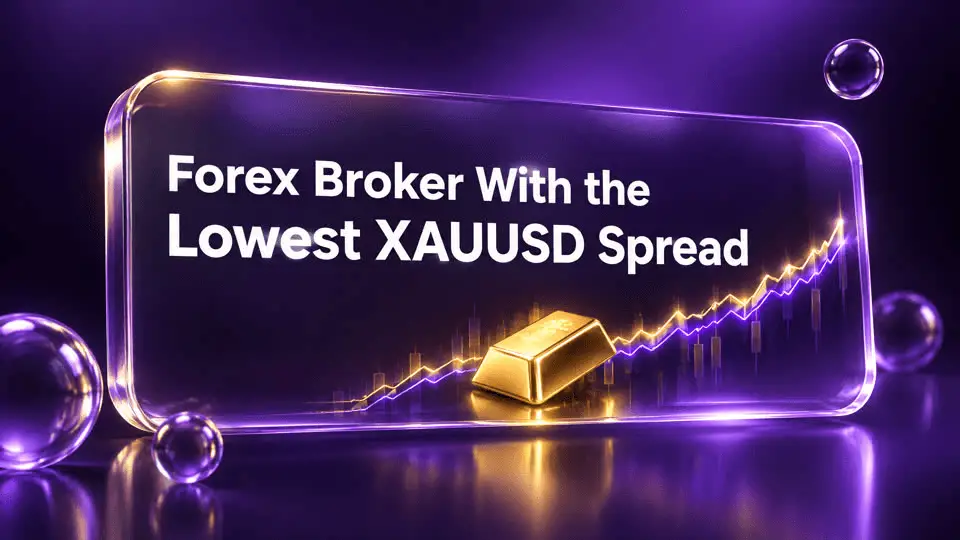
This matters more for XAUUSD than almost any other instrument, because gold's price per point is large. A 0.10-point difference in spread on a currency pair barely registers. On gold, it can be the difference between a scalping strategy that survives and one that quietly bleeds out over a few hundred trades.
Below is a straight comparison of the brokers that currently publish the tightest XAUUSD pricing, followed by the math you actually need to run before opening an account.
Among brokers that publish transparent, verifiable XAUUSD pricing tables, IC Markets' Raw Spread account currently shows the tightest headline numbers — a minimum spread around 0.05 and an average close to 0.09–0.12 during liquid sessions. Pepperstone Razor and Tickmill Raw sit just behind it, both advertising gold spreads starting near 0.08, with Tickmill undercutting on commission at $3 per lot per side versus the $3.50 charged by IC Markets and Pepperstone on their standard MetaTrader Raw/Razor accounts.
None of that answers the question for you individually, though — because the account that wins on paper isn't always the one that wins for your trading style. Here's the breakdown.
|
Broker |
Account |
Published spread |
Commission (round-turn, 1 lot) |
Regulator (entity-dependent) |
|
IC Markets |
Raw Spread |
~0.05 min / ~0.09–0.12 avg |
$7.00 ($3.50/side) |
ASIC, CySEC, FSA |
|
Pepperstone |
Razor |
From 0.08 |
$7.00 ($3.50/side) |
ASIC, FCA, CySEC, DFSA |
|
Tickmill |
Raw |
0.08 min / 0.09 typical |
$6.00 ($3/side) |
FCA, CySEC, FSA, FSCA |
|
Exness |
Raw Spread |
Tight, account-dependent |
Varies by entity |
FCA, CySEC, FSCA, FSA |
Figures reflect each broker's own published pricing pages as of September 2026 and are indicative only — live spreads move constantly with liquidity and volatility. Always check the real-time spread in your own account before assuming a number from any comparison article, including this one.
A spread is only one line item in the cost of a trade. On a raw or ECN-style gold account, you're typically paying three things every time you open and close a position:
A broker that markets “XAUUSD from 0.0” is not offering free trading. It's usually offering a commission-based account where the spread has been compressed toward zero and the broker's margin has moved into a separate line item. Ignore that separation and you'll misjudge your real breakeven distance on every single trade.
Say you trade 1 standard lot of gold on a Raw account with a $3.50-per-side commission and an effective spread cost of roughly $10 (spread expressed in price terms on a 100-oz contract).
Now compare that to a broker charging a slightly wider spread — say $14 — but zero commission. Round-turn cost: $14. The “wider spread” broker was actually cheaper for that trade size.
This is precisely why minimum-spread marketing numbers are close to useless in isolation. Run this math with your own typical lot size before choosing a broker.
Prioritize the average spread during your actual trading hours, not the advertised minimum, which usually only appears in the deepest London/New York overlap liquidity. IC Markets' Raw Spread account is built specifically for algorithmic and high-frequency strategies, with pricing aggregated from dozens of liquidity providers and no restrictions on hedging or minimum order distance — both of which matter if your EA places orders close to the current market price.
Commission becomes the deciding variable once trade count climbs into the hundreds per month. Tickmill's $3-per-side Raw commission versus a $3.50-per-side structure saves $1 per round-turn lot. That sounds trivial until you multiply it by 500 trades a month — $500 in saved commission alone, independent of spread.
Spread comparisons matter far less than swap rates once you're holding positions across rollover. A tight-spread broker with an unfavorable overnight financing rate on XAUUSD can end up costlier over a multi-day hold than a broker with a slightly wider entry spread but better swap terms. Always pull the current swap rate from the platform itself — swap rates move with interest rate differentials and are not fixed the way a commission schedule is.
Don't default to a Raw/ECN account just because it has the smallest headline spread. If you're placing a handful of trades a month at 0.1–0.2 lots, a commission-free standard account can easily work out cheaper once you account for the fixed per-lot commission a Raw account charges regardless of position size.
XAUUSD isn't a currency pair, and it doesn't behave like one. Spreads on gold widen noticeably around:
A broker publishing a 0.05 minimum spread might realistically show 0.30–0.50 during a CPI print. That's not necessarily bad execution — it's how underlying liquidity actually behaves. The brokers worth shortlisting are the ones that publish both a minimum and an average, since the average tells you far more about what you'll actually pay on a typical Tuesday afternoon.
If you want the tightest published XAUUSD number today, IC Markets Raw Spread is the broker to start with. If commission efficiency matters more because of your trade volume, Tickmill Raw closes the gap. If you want a broad multi-platform setup with strong execution alongside competitive gold pricing, Pepperstone Razor is worth testing.
But treat every number in this article — and every number on a broker's marketing page — as a starting point for your own calculation, not a final answer. The broker with the smallest spread on a comparison chart is not automatically the broker that will leave you with the most money at the end of the month. Run the total-cost math for your own lot size, trading frequency, and holding period, and let that number make the decision.
Which forex broker has the lowest XAUUSD spread in 2026?
IC Markets currently publishes the tightest headline XAUUSD spread among major raw-pricing brokers, with a minimum around 0.05 and an average near 0.09–0.12. Pepperstone Razor and Tickmill Raw are close behind.
Is a 0.0 XAUUSD spread actually free to trade?
No. Near-zero spreads almost always come with a separate per-lot commission. Total cost is spread plus commission plus any overnight swap, not the spread figure alone.
Is spread or commission more important for gold trading?
It depends on your lot size and trade frequency. Larger, less frequent trades are more spread-sensitive; smaller, high-frequency trades are more commission-sensitive. Calculate the round-turn cost for your own typical trade before deciding.
Do XAUUSD spreads change throughout the day?
Yes, significantly. Spreads are tightest during the London/New York overlap and widen around economic releases, rollover, and thin Asian-session liquidity.
Should I hold gold positions overnight with a low-spread broker?
Only after checking the swap rate. A broker with the tightest entry spread isn't necessarily cheapest for multi-day holds if its financing rate on gold is unfavorable.
Editorial note: Spreads, commissions, swap rates, leverage limits and regulatory coverage change frequently and vary by legal entity and account type. The figures in this article reflect publicly available broker pricing reviewed in September 2026 and should be independently verified on the broker's own platform before trading. Trading forex and CFDs carries a high level of risk and may not be suitable for all investors.